Our Easter Morning, Start to Finish
Easter morning in our house doesn’t look like a catalog. There’s no matching outfits, no perfectly coordinated eggs, no one standing still for a photo. There’s flour on my apron from last night’s rolls, Duke’s muddy paws on the kitchen tile, and somewhere in the basement, Mason can’t find his good shoes. But the light coming through the kitchen window at 5 AM is golden, and the coffee is something warm in my hands, and the whole day stretches ahead — this day that means everything and looks like nothing Pinterest-ready.
This is how we celebrate Easter. This is what it actually feels like in our farmhouse kitchen, from before dawn until after dark. Not the Instagram version. Just us.
Before Dawn
I wake at 4:45 without an alarm — not because I’m naturally a morning person (I’m not), but because my body knows something is happening. Easter. Resurrection. A day that asks us to pay attention.
The house is quiet and cold. The furnace takes its time, as it always does, and I pull my cardigan tighter walking down to the kitchen. Jake might be home or might be on rotation up North — this year, it’s rotation week, so it’s just me and the sound of my own footsteps on the hardwood. That used to make me sad. Now I’ve learned to listen to what it means: time that’s just mine before the chaos of three kids and a golden retriever who doesn’t understand why he can’t help with the coffee.
The kitchen smells like the butter I used yesterday for something warm — pie crust, or rolls, or the simple biscuits my grandmother taught me to make on Saturday mornings. Nana Ruth has been gone five years, but her cast iron skillet is sitting on the stovetop like she just stepped away. Some mornings, I think about how she would have loved to see the grandkids now. Other mornings, I’m sure she’s seeing exactly what she meant to see: her recipes coming alive in my hands, her legacy not lost but living.
I start the coffee — not because I need the caffeine yet, but because the ritual matters. The sound of water filling the pot. The smell of it brewing. The moment when the kitchen shifts from cold to warm, dark to light. This is how I prepare myself to lead a day like Easter. Not with a prayer said in a rush, though I’ll say one once the kids are awake and our voices are together. But with my hands making something warm, my body in the kitchen where my grandmother stood, my heart quieter than it will be for the rest of the day.
I stand at the window while the coffee brews. The yard is still gray-brown with the last of March, the gardens I’ll plant in another month nothing but idea right now. The mailbox looks small and lonely. Duke comes down the stairs and puts his big head on my leg, and I scratch behind his ears without even thinking about it — the way you touch something you love when you’re not paying attention. Just right. That’s how it happens. Not planned or posed, but just right.
By the time the coffee is ready, I’ve thought about what Easter means in a way I wouldn’t have time to think about it if there were voices upstairs. Resurrection. Not just the theological kind — though that’s the whole thing, the reason we gather, the grace that holds us. But also the smaller resurrections. The garden coming back. My grandmother’s methods living through my hands. My marriage surviving rotation weeks and tight budgets. My kids growing, changing, becoming themselves. All of it rising again.
I make toast. Butter it while it’s still warm so the butter soaks in. Eat it standing up at the counter, tasting each bite. This is my prayer: being present for the day, being grateful for the quiet, being ready for the noise that’s coming.
The Kids Wake Up
Wyatt comes down first. He always does. He’s like his father that way — built to be awake, to be moving, to be responsible. At ten, he’s already got a watch he checks constantly, and this morning he’s checking it because he knows there’s an egg hunt and he wants to be the first to know when they can go. His dark hair is sticking up in three directions, and he’s still in yesterday’s t-shirt, but his eyes are bright.
“Is it time yet?” he asks, and I’m pretty sure he means several things: time to eat, time to search, time for Easter to officially begin.
“Almost,” I tell him. “Help me with the pancakes?”
He’s old enough now that helping means something. He cracks eggs with surprising confidence, though one shell piece ends up in the bowl and he looks devastated until I fish it out and show him it’s fine. “Happens to me all the time,” I say, and I watch him relax. He’s learning, slowly, that things don’t have to be perfect to be good. I’m learning too.
Clara comes down before Wyatt finishes his second egg crack. She’s already dressed — organized at nine in a way I will never be — and she’s holding her little recipe notebook, the one Nana Ruth gave her before she died. She keeps it for moments like this. No one asked her to; she just knows that holiday cooking is worth writing down.
“Can I make the chocolate sauce for the pancakes?” she asks. It’s not really a question. Clara doesn’t ask permission the way Mason does, tentatively. She asks like she already knows the answer is yes, and usually she’s right.
“Good idea,” I tell her. “Check the cabinet — we have that bottle of syrup we’ve been saving.”
She moves around the kitchen the way I move, efficient and sure. She pulls out the small pot, the right wooden spoon, the ingredients she needs. There’s something warm about watching her do this — not just pride, though there’s that. It’s seeing your own ways passed forward, watching your hands become her hands, your kitchen becoming her kitchen. Nana Ruth used to do this, let me take over the small tasks, and now I’m doing it for Clara. This is how traditions stay alive. Not in recipes written down (though those matter). In the hands that know how to do things, the confidence that comes from being trusted.
Mason appears last, as always. At seven, he hasn’t figured out yet that morning is something you can own. He wanders down the stairs like he’s surprised to find them, rubbing his eyes, looking confused about what century it is.
“Is it Easter?” he asks, which seems like an unnecessary question, but I’ve learned that with Mason, you don’t assume he knows the time or the day or what we’re doing. Yesterday feels like today to him. Tomorrow hasn’t been invented yet.
“It’s Easter,” I confirm, and he lights up like someone turned on a switch inside his whole body.
“Do we hunt eggs?” he asks.
“After breakfast.”
“Is Dad here?”
“Not yet, buddy. He’s still working.”
Mason absorbs this without the sadness I feel on rotation weeks. To him, Dad is coming home sometime (eventually, definitely), and eggs are happening (definitely, immediately), and that’s enough information to begin with.
I read the Easter story to them while the pancakes cook — nothing fancy, just from a children’s Bible we’ve had since Wyatt was born. The actual story is strange for kids: death and garden and resurrection and stone rolled away. But I read it matter-of-fact, and they listen because their mother is reading and because the words are true, and because somehow the big truth gets smaller when you speak it out loud in your kitchen with flour still on the counter.
“That’s why we celebrate,” I tell them. “Because something that was dead came back to life.”
Wyatt nods like he already knew that. Clara is writing something in her notebook. Mason is thinking about eggs, you can tell. But they’re listening. And I’m teaching them something about how we live, not just what we eat.
The Egg Hunt
The eggs are hidden in the yard, hidden by my own hands last night after the kids were asleep. I know where every one of them is — under the porch eave, tucked into the garden fence, sitting in the crook of the old oak tree’s lowest branch, buried in the mulch near the shed. I’ve hidden different things in different eggs: some are just hard-boiled with names written in marker. Some have scripture verses folded inside (Clara’s will have verses about hope and growth; Wyatt’s will have verses about courage; Mason’s will have jokes I found online that he won’t quite understand but will laugh at anyway). Some have small things: a dollar coin, a temporary tattoo, a wrapped piece of good chocolate.
Duke follows us into the yard like he’s part of the hunt, which he is, his way. He’s not interested in finding eggs so much as hoping someone will drop chocolate. He stays near Wyatt, optimistic that chaos means opportunity.
The morning is cool and slightly damp, the kind of spring morning where you can feel the whole year turning over. The kids spread out, and I stand on the porch with my coffee getting cold in my hands and watch them do this thing — hunt for eggs, hunt for treasure, hunt for meaning in symbols that are fun and deep both at once.
Wyatt is systematic. He’s checking logical places: under bushes, on the fence post, the kind of spots that make sense if you were hiding something where it could be found. He finds four quickly, satisfied with his strategy working.
Clara is methodical in a different way. She’s looking at the yard like a puzzle, thinking about where someone would hide something, thinking like I think. She finds them one by one, and I can see her checking each one before she puts it in her basket — making sure it’s intact, making sure she didn’t miss anything.
Mason is chaos and luck combined. He’s not searching so much as wandering, and somehow he finds some of the good ones. He discovers the egg hidden in the oak tree branch because he’s looking up at the birds instead of down at the ground. He finds the one in the mulch because he trips and falls and looks down to steady himself. Pure Mason luck.
There are tears for a moment — because there are always small tears on mornings like this — when Mason thinks Wyatt found one he wanted. But then I help him understand that there are enough for everyone, and besides, look what he found instead, and the tears dry up and we’re moving again. The chaos is real. The resolution is simple.
Duke never catches an egg, thank goodness. But he stays close, available for any accidentally dropped chocolate, ready for whatever excitement might unfold. He’s the background presence that makes it all feel like home — not the focus, but the steady companion, the one who shows up for the chaos just because his people are in it.
Once they’ve found them all, once the baskets are full and their hands are dirty, we sit on the porch steps and open them. The verses are read aloud. The jokes are laughed at (even the ones that don’t quite land). The chocolate is eaten immediately. The coins are pocketed for later spending. And for a moment, it’s just us — three kids and their mother and a dog with his head on Mason’s knee — and everything we’re celebrating feels as simple as treasure in an egg and as deep as resurrection itself.
Breakfast Gathering
The kitchen has been calling me the whole hunt. The pancakes need to finish, the scrambled eggs need attention, the toast needs buttering. Clara made chocolate sauce, and Wyatt set the table without being asked (placing forks and knives with maybe not perfect accuracy but with genuine effort). Even Mason brought napkins, one in each hand like they were treasures.
We gather around the big wooden table, the one that seats six with room to squeeze in more. Right now it’s just five — Wyatt on one side, Clara in the middle, Mason fighting with a chair that’s too tall for him, me at the head, and the empty chair where Jake would be if he were home. I don’t make a big thing out of that empty chair. We all notice it. That’s enough.
The pancakes are thick and orange-spotted with carrot, and they taste like spring because we added a tiny bit of cinnamon. The eggs are actually scrambled the way you’re supposed to scramble them — low heat, butter, patience — and they’re creamy and just right. There’s toast with too much butter on it. There’s orange juice with pulp that makes Mason make a face. There’s this moment where everyone is full-mouthed and quiet, just eating.
I watch them eat. This is what my life is: three people who came from my body, around a table, eating food my hands made for them. The light comes through the kitchen window and hits Clara’s hair and makes it look like dark honey. Wyatt’s got butter on his chin and he doesn’t even notice. Mason is dipping his toast into the egg because he’s discovered that’s how toast should be eaten, and I’m not correcting him because he’s right.
This is when I think about what matters. Not the eggs or the food or the perfect kitchen. This: everyone I love around a table. Fed. Present. Here.
“I’m still hungry,” Wyatt says, and I get him more.
“Can we do more chocolate?” Mason asks, and I tell him after his egg, maybe.
Clara is watching the last pancake like it might disappear, and I slide it onto her plate before anyone else can ask.
“Jake called this morning,” I remember to tell them. “He said Happy Easter. He’s proud of you guys for doing the hunt.”
Mason nods like that’s settled and right. Wyatt looks sad for half a second, then doesn’t. Clara keeps eating. This is what I’ve learned about kids on rotation weeks: they’re resilient in ways I didn’t expect, and they also don’t need me to fix the sadness. Just acknowledge it. Let it exist alongside the pancakes.
Grace isn’t something we always remember to say on regular mornings, but we say it on Easter. We hold hands around the table, and I’m aware of their small hands in mine, the warmth of them, the trust of it. I say something simple: “Thank you for this food, and for this family, and for being together on this morning that means everything. Help us remember what matters. Amen.”
Three little “amens” that sound like Easter itself.
After Breakfast: Rest Moment
After breakfast, the kids scatter in that way they do — Wyatt to his eggs and treasure, Clara to her notebook, Mason to the living room where he’s arranging eggs like they’re an art installation. Duke follows Mason, hoping more chocolate appears. The breakfast dishes are stacked in the sink, and normally I’d jump on them immediately, but this morning I don’t. This morning I stand in my kitchen with the light still golden, the smell of cinnamon and butter still hanging in the air, and I let myself pause.
This is the moment where I feel Nana Ruth most clearly. Not as a ghost, not as something scary, but as a presence. She used to make these moments, too. She’d cook something, feed people, then stop and look at what she’d made. She’d call it “knowing what you’ve done.” I do that now. Stand still in the kitchen. Feel the warmth of the meal you’ve just made still radiating off the stove. Understand, for a second, that this is how you love people. With something warm. With hands that know. With presence instead of perfection.
I wash the dishes slowly, not because I have time (I don’t) but because my hands in warm water is something I need right now. The food scraps wash away. The butter rinses clean. The forks and spoons come back to themselves, shiny and ready for dinner. This is meditative, I guess, though I wouldn’t have called it that before I became a mother. I would have called it drudgery. Now I call it space to breathe, space to remember, space to know that I’m doing something that matters.
The rest of the day stretches ahead — dinner to prepare, a house to not worry too much about, time with my children who are growing up at a speed that makes me dizzy. But right now, in this moment, with the kitchen quiet except for the sound of water, with my hands in something warm, I’m present for it. I’m here. And that’s enough.
The Dinner Preparation
By noon, the kitchen shifts into a different gear. Most of the heavy work was done yesterday — the Jake’s Bourbon Maple Glazed Easter Ham was already in the fridge, the rolls already proofed and ready to bake, the casseroles assembled and waiting. This is the payoff of the make-ahead planning. This is why I spend hours prepping the week before. Because today, on this day, I don’t want to be stressed in the kitchen. I want to be present for my kids, present for the meaning of the day, present for the gathering that’s about to happen.
The ham goes in the oven at 1 PM. The house fills with that smell — salty, sweet, unmistakable. It’s a smell that says “something warm is happening” without me saying anything at all. Mason comes into the kitchen to investigate. “Is it dinner?”
“Not yet,” I tell him. “But getting close.”
The rolls come out of the freezer, where they’ve been since Tuesday. I set them on a pan to proof for an hour, and the kitchen smells like yeast and butter and Easter. The table, set last night with the spring napkins I found on sale, looks ready. The casseroles go into the oven to warm. I don’t have to think too hard about any of this; my hands just know what to do next.
Clara appears while I’m doing vegetables — she wants to help, wants to contribute. I give her a job: arranging the salad from the big wooden bowl into the smaller serving dish, making it look nice. She takes it seriously. This is Clara — everything she does is done like it matters, because to her, it does.
Wyatt is busy in the living room with something I don’t need to understand. Mason is napping, finally — Easter morning is exhausting in the way only childhood can be exhausting, and he’s curled up with Duke like they’re litter mates. Jake still isn’t home, but he called this morning, and I know he’s thinking of us. That’s enough.
By 4 PM, everything is ready. The ham is resting. The rolls are golden and warm, ready to butter. The vegetables are cooked, the casseroles are holding at a gentle temperature, everything is just right. I stand in my kitchen and I think: this is the point of all the planning. Not because I’m Martha Stewart, but because I’m a mother who wants to sit at a table with her kids instead of being in the kitchen stressed and distracted. I want to be present for the gathering. And because I planned, because I made ahead, because I said no to perfection and yes to presence, I can.
I pour myself something warm — hot tea, this time, not coffee — and I sit at the kitchen table for five minutes. Just five. Clara might come down; Mason might wake up; Wyatt might need something. But for five minutes, I let myself be still. Let myself feel proud. Let myself know that I’ve done something that matters, not because it’s fancy or impressive, but because it’s done with love, done with intention, done with hands that know what family needs.
Easter Dinner Moment
Everyone gathers at 5:30. Wyatt emerges from his morning chaos clean and ready. Clara appears in a nicer dress she picked out herself, wanting to mark the day as special (she’s learning to do this, to make a day feel different by making herself feel different). Mason wakes up grumpy and then not grumpy once he realizes the food is happening. Jake calls again, closer to home, maybe an hour away, and his voice sounds like someone who’s been working, but his words are all heart: “Tell them Dad can’t wait to see you all.”
When Jake is away, we set his chair with a plate anyway. Some people might think that’s sad. I think it’s honest. He’s part of this even in his absence. It’s good for the kids to know that. And when he eventually gets home (maybe late tonight, maybe tomorrow), he’ll know the meal was ready for him, that we gathered thinking of him.
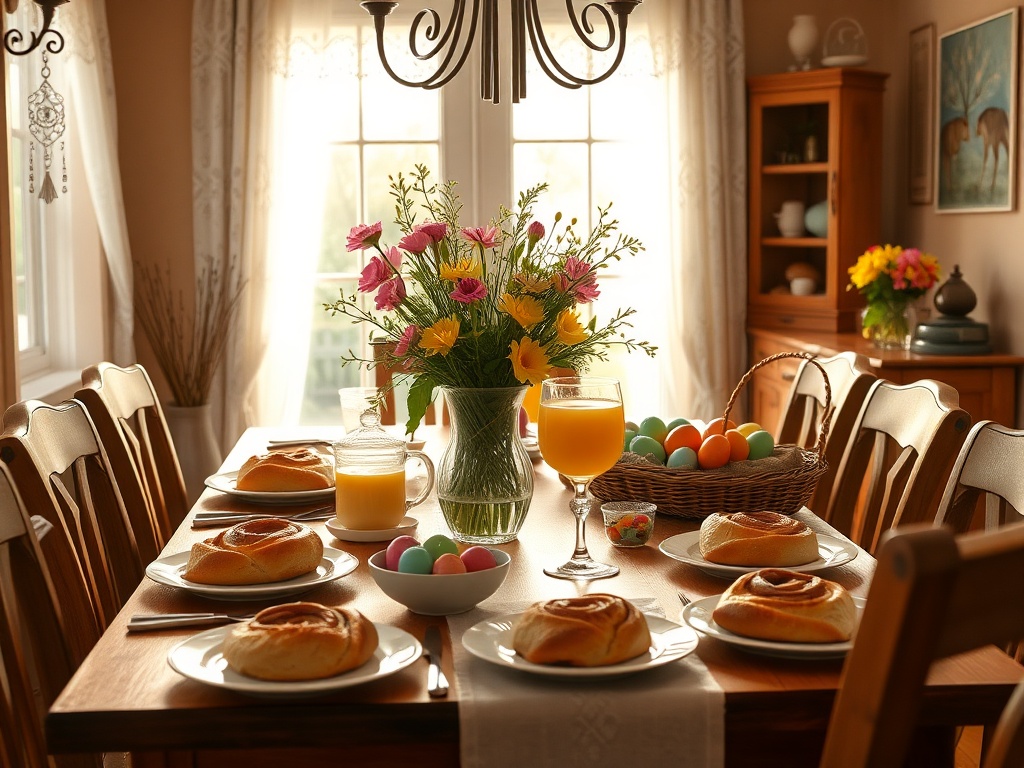
The table looks like our table — the good plates that don’t match but all somehow work together, the mismatched napkins, the glasses that range from crystal to cartoon characters, the food in the middle. This is not a styled table. This is a real table where a real family is about to sit down.
I light the candles. Nothing fancy — just the regular tapers we always use, nothing specific to Easter, but the light changes everything. It makes the ordinary table look somehow sacred. Not because candles are magic, but because light makes you pause, makes you see what you’re looking at.
We hold hands for grace. I’m always aware in this moment that this is temporary, that Wyatt will soon be too cool for hand-holding, that Mason will grow past the gap-tooth stage, that Clara will have her own kitchen and her own table someday. But right now, their hands are in mine. Warm and real.
“God, thank you for this food. Thank you for this family. Thank you for the promise of Easter — that resurrection isn’t just something that happened two thousand years ago, but something that happens every spring, every time we choose to begin again, every time we gather like this. Help us remember that this moment, this table, this family — this is what matters. Amen.”
Three little amens. Duke’s tail thumping against the floor even though he’s not part of the prayer but he knows it means food is coming.
And then we eat.
It’s not quiet. Wyatt and Mason are doing something with the dinner rolls that makes them laugh. Clara is eating methodically and carefully, tasting each thing, the way she tastes. Someone spilled water but it’s water, not a disaster. The ham is good, actually really good. The rolls are the best they’ve been — I think maybe because they’ve been frozen, and somehow that makes them taste better on defrost. The vegetables are honest vegetables. Nothing is fancy, but everything tastes like home and intention and “something warm.”
I watch them eat. I watch Wyatt’s competitive joy as he eats more than everyone, something he’s very proud of. I watch Clara pay attention to how things taste, already thinking like a cook. I watch Mason get more on his face than in his mouth, and I love him for it. I watch Duke watch them, hope eternal in his brown eyes. And I feel, very clearly, Nana Ruth. Not in a spooky way. Just in a “her methods are alive in my hands” way. In a “her legacy is not lost” way. In a “this is exactly what she meant” way.
“Tell us about the hunt,” I ask, even though I was there. I ask because I want to hear their version. I want them to tell their story.
Wyatt talks about strategy. Clara talks about finding the one in the tree. Mason talks about the chocolate, then the jokes, then he forgets what he was saying. They talk over each other, which is fine. The conversation is messy and real and full of their voices. This is Easter in our house. Not quiet, not perfect, not Pinterest. Just this: family around a table, faith woven into the simple fact of gathering, food as the language we use to say “I love you” and “you matter” and “let’s do this again next year.”
Jake texts: home in 40 minutes. I don’t tell the kids because I want to see their faces when the truck pulls up. That’s a moment just for them. Just for all of us.
Closing: Why This Matters
The day is long by the time the dishes are done and the leftovers are wrapped. Maggie’s Easter Dinner Menu sits in the fridge like a promise we can keep eating. The table is cleared except for Mason’s egg he wanted to keep (it’s going weird in the corner, but I’m not making a thing of it). The kids are winding down, finally, the adrenaline of the day catching up with them.
This is what I want to tell anyone reading this: Easter doesn’t have to look like anything. It just has to look like gathering.
I don’t have a Pinterest-perfect home. I don’t have matching place settings or a professional photographer or a marketing plan for the day. I have three kids, a dog, a kitchen that’s not trendy, and a heart that knows what matters. I have recipes my grandmother taught me and a table where we sit together.
Easter isn’t about the eggs being hidden in the right places or the food being Instagram-beautiful or the outfits being coordinated. Easter is about something deeper: the choosing to gather, the choosing to say “we matter,” the choosing to cook and eat and be together when the world makes that harder every year.
It’s about knowing, in your bones, that resurrection isn’t just a one-time religious thing. It’s what happens when you show up for your family even though you’re tired. It’s what happens when you make something warm with your own hands. It’s what happens when you pass down a recipe and a way of being and the knowledge that “hands that know” things is the greatest gift you can give someone. It’s what happens when you let grace exist alongside imperfection.
My grandmother is gone, but she’s here. She’s in the way Clara holds a wooden spoon, in the way I move through the kitchen, in the way we gather together and think of what matters.
I’m not telling you to do Easter exactly like we do. I’m not saying my table should look like your table. I’m saying: make this your own. Make it look like love in your kitchen. Make it taste like your family’s story. Make it mean something because you decided it does.
That’s what Easter looks like in our house: faith and chaos and joy, all at the same table, all just right.
When Jake comes home at 6:15 (early, finally, and the kids scream when they see his truck), the first thing he does is eat the leftover ham. The second thing he does is pull me into a kiss that’s grateful and warm. The third thing he does is sit with his family and know that this, this is the point of everything.
This is what we’re celebrating. This: presence. Family. The hands that know how to feed each other. The grace that makes imperfection beautiful.
Just this. Just right. Just us.
If you’re just getting started on your Easter planning, read Easter Without the Stress first—it gives you the three-week roadmap. And if you’re setting the table, check out Easter Cooking with Your Kids and Easter Table Setting Ideas for DIY placecard designs and color stories.
The first thing we do every Easter morning is make Resurrection Rolls together — get the recipe and the story behind our tradition.
Join the Kitchen Table
Get Maggie’s newest recipes, seasonal guides, and a little warmth in your inbox. Free, always.