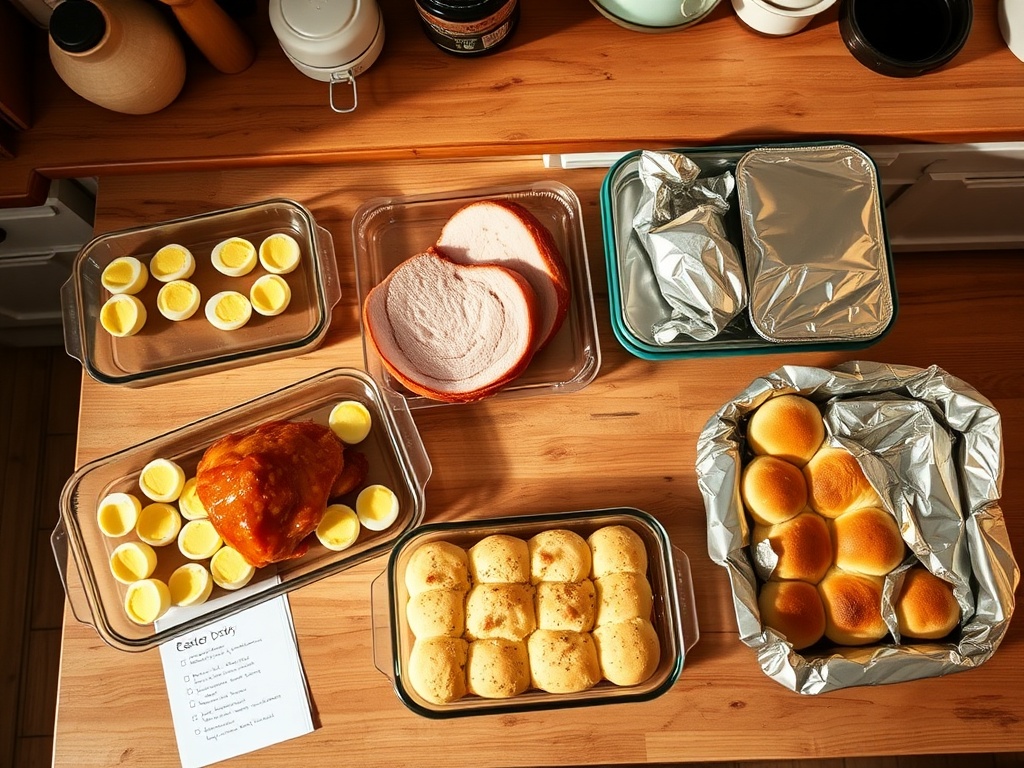
Easter Without the Stress: Make-Ahead Recipes & Timeline You Can Actually Follow
Three weeks before Easter, I’m already thinking about what can go in the freezer.
It’s not because I’m some kind of meal-planning saint. It’s because I’ve learned through years of mild panic that the difference between Easter morning feeling like a gift and Easter morning feeling like a deadline is planning. Real planning. The kind where you break it into pieces small enough that none of them feel impossible.
Jake is working rotation the week before Easter half the time—I can’t count on him being home to help with last-minute prep. The kids have school until the Wednesday before, which means I’m juggling homework and meal planning simultaneously. The kitchen is the size of a small airplane bathroom. And I want Easter dinner to feel like something warm, gathered, and utterly unstressful. Not because I’m naturally organized (I’m not), but because I’ve learned that managed clutter beats last-minute panic every single time.
This isn’t a collection of fancy recipes or a Pinterest-perfect timeline that assumes you have a pristine kitchen and unlimited time. This is what actually works when you’re managing three kids, a real budget, and a legitimate desire to enjoy your family instead of standing over a hot oven in your good clothes.
The Master Timeline: Three Weeks to Easter Morning
The secret to an unstressed Easter isn’t doing everything at once. It’s doing the right things at the right time, in the right order. Here’s how I break it down—and why each phase matters.
Three Weeks Before Easter (March 13-20)
What You’re Actually Doing: Thinking clearly, without panic.
This is the week to nail down what you’re serving. Not Pinterest-aspirational recipes. Real food your family will eat. For us, that usually means a good ham, something with vegetables, rolls (always rolls), and a dessert that doesn’t require three hours of oven time.
Once you know the menu, here’s what happens:
Menu Finalization Checklist
– What’s the main dish? (Ham, prime rib, standing rib roast—pick one that makes sense for your oven space and budget)
– What are three sides? (Potatoes, vegetables, something starchy or saucy)
– Are you making rolls from scratch or buying them? (Honest answer: both is fine)
– What’s the dessert? (Choose something you’ve made before or that doesn’t require day-of babysitting)
– Any dietary things you forgot about? (Gluten-free, vegetarian, allergies—note them now)
Shopping List Creation
Make a list organized by store section: produce, meat, dairy, pantry. I do this by hand in a notebook because I’m ancient, but a phone note works too. The point: know what you need before you get to the grocery store. Saves time, saves money, saves the mental energy of standing in front of the dairy case wondering if you already have enough butter. (You don’t. Buy more butter.)
Freezer Prep List
Look at your menu and ask: What can I make in advance? For us, that’s usually three things:
– Casseroles (ham and cheese potato bake, green bean casserole, that sort of thing)
– Rolls (dough freezes beautifully)
– Maybe a dessert (brownies, shortbread, whatever doesn’t require last-minute frosting)
Write these down. Seriously. Your future self will be grateful.
Two Weeks Before Easter (March 20-27)
What You’re Actually Doing: Batch cooking while everyone’s still at school.
This is the best week. The kids are in school. Jake’s either working or (if he’s home) occupied elsewhere. You have maybe a two-hour window most afternoons, and you use it to make and freeze the things on your list.
Batch Cooking Days
Pick two afternoons when your kitchen is free. Set a timer. Make one recipe at a time—not five. The goal isn’t to be a hero. It’s to get three things frozen so three things aren’t hanging over your head in two weeks.
Example batch week at our house:
– Monday: Ham and cheese potato casserole (assembly only, unbaked; freezes raw)
– Wednesday: Two batches of roll dough (frozen separately; thaws overnight)
– Friday: Shortbread or brownies (already baked; freezes as-is)
As you make each thing, label it clearly. Not cute labels. Practical labels. Date, what it is, and how to thaw/reheat. (“HAM POTATO BAKE — FREEZE RAW — BAKE 350°F 45 MIN COVERED” is perfect.)
Freezer Organization
Designate a section of your freezer (one shelf, one corner, whatever) as your Easter zone. Organize by meal timing: Easter dinner items on one side, brunch items on the other if you’re doing both. Line things up so you can see what’s there. You’re not being precious about it. You’re being practical.
Dough Prep Magic
If you’re making rolls, this is the week. Roll dough freezes beautifully. Make your dough, let it rise once if the recipe calls for it, shape it, freeze it on a baking sheet, then pop the frozen rolls into a gallon bag. Thaw overnight in the fridge or on the counter for an hour before baking. Same quality as fresh. None of the panic.
Why is dough great for batch cooking? Because it takes time but isn’t complicated, and it takes up your oven early in the week when you’re not also roasting ham.
One Week Before Easter (March 27 – April 2)
What You’re Actually Doing: Prep work that makes Easter morning actually restful.
This is the week things shift from “making” to “organizing.” Your freezer is stocked. Your list is solid. Now you’re setting yourself up for success.
Defrost Strategy
On Monday of this week, move freezer items to the fridge in the order you’ll need them. Raw casseroles go in first (they can take their time). Baked items go in later (they don’t need as much thaw time). This is just moving things around, but it’s the difference between Easter morning having items ready to go and Easter morning playing Tetris with your fridge.
Ingredient Prep (Mise en Place, but I just call it “getting organized”)
Pull out any fresh produce that needs chopping. Asparagus that needs trimming. Carrots that need peeling. Do this on Tuesday or Wednesday. Put chopped items in containers so they’re ready to go. Not for some fancy cooking reason. Just so you’re not doing vegetable prep on Easter morning when you could be with your family.
Setting the Table
I know this sounds wild. Why set the table a week early? Because the special tablecloth probably needs ironing. The napkins might need to be located. The candles get lit. You’re spreading the work across the week instead of doing it Sunday night when you’re already tired.
We use our regular table and good dishes (not fancy china—just the nicer plates), add a tablecloth, fold some napkins nicely, and put out candles. Do it Wednesday night. Leave it. Nobody eats at that table for a week, but it looks like what Easter looks like. It makes the house feel like something’s happening.
What the Kids Can Actually Do
Assign each kid one small task. Wyatt can fold napkins (he’s old enough to do them nicely). Clara can set out water glasses. Mason can put a flower or sprig of greenery at each place. Not because you need their help. Because when kids contribute, they care. And because it’s one less thing you’re doing alone.
Two Days Before Easter (April 3rd)
What You’re Actually Doing: Final touches and reality checks.
The ham’s thawing. The potato casserole is in the fridge. Your table is set. This is the administrative day.
Final Shopping
Do you have fresh greens for a salad? (You forgot, didn’t you?) What about the one ingredient you wrote down three weeks ago and then forgot about? Go to the store. Buy it. Buy extra butter. You always need more butter.
Set Out Serving Dishes
Pull out the platters, bowls, and utensils you’ll actually use. Set them on the counter where they need to go. Doing this now means you’re not hunting for a serving spoon at 6 PM when the ham’s hot and everything’s ready.
Assign Family Tasks
Not cooking tasks. Gathering tasks. Who’s setting out water? Who’s calling people to the table? Who’s clearing the appetizer plates? Who’s responsible for making sure Duke doesn’t eat the ham? (That’s always Wyatt. Duke’s weakness is Wyatt’s supervision.)
Make these assignments clear and before the meal starts. Not during. During is chaos.
Day Before Easter (April 4th)
What You’re Actually Doing: Final assembly and mental prep.
This is the day you feel like you might be losing control, and then you sit down and realize everything is basically ready. This is a gift.
Assemble Cold Dishes
Salads that can sit overnight go together. Deviled eggs get made. Anything that’s better the next day happens today.
Prep Hot Dish Vegetables
If your ham needs scored and glazed tomorrow, do the prep today. If your vegetable side needs assembling, do that. You’re not cooking. You’re preparing. Big difference.
Clear Fridge Space
Make room. Pull out anything you don’t need. Consolidate. This seems silly, but when you’re trying to fit a platter of ham into an already-full fridge on Easter morning, you’ll thank yourself.
The Evening Before (Yes, Really)
Put on something comfortable. Sit with a cup of something warm. Walk through your menu one more time. Not to panic. To confirm that everything’s ready. Everything is ready. You already made it. You already prepped it. Tomorrow is just assembly and warmth.
Easter Morning (April 5th)
What You’re Actually Doing: Being with people instead of cooking.
This is the whole point.
When everyone wakes up, the kitchen shouldn’t be demanding. The rolls go in the oven. The ham goes in the oven. The casserole goes in the oven—maybe. Some things are already hot and just need reheating. You have time to read the Easter story to the kids. Time to get dressed without flour on your pants. Time to actually gather instead of frantically finishing.
The Heat-and-Hold Timeline
Assume your oven is 350°F unless your recipe says different.
– 7:00 AM: Put on coffee. Light the candles on the table.
– 7:30 AM: Rolls go in. (15-20 minutes if frozen; thaw them first if you have time)
– 8:00 AM: Ham goes in. (Usually 15 minutes per pound at 350°F, plus 15 minutes extra for being frozen)
– 8:00 AM: Cold dishes come out of fridge and get positioned.
– 8:30 AM: Casserole goes in if it’s cold from the fridge. (Add 10-15 minutes to bake time if frozen)
– Anytime: Vegetable sides heat on the stovetop in the last 15 minutes.
The goal: Everything hits the table warm at the same time. And if it doesn’t? Serve it slightly warm instead of slightly cold. Nobody cares.
What the Kids Actually Do
– Mason can pour water.
– Clara can light the candles (with supervision, obviously).
– Wyatt can help the youngest bring dishes to the table.
– Nobody is cooking. Everyone is gathering.
Freezer-Friendly Recipe Strategies: What Freezes and What Doesn’t
Not everything freezes well. And some things freeze great but need specific handling. Here’s what I’ve learned through trial and (many) error.
Dishes That Freeze Beautifully
Casseroles (Assembled, Not Yet Baked)
Raw or partially cooked casseroles freeze better than baked ones. Ham and cheese potato bake? Freeze it before you bake. Green bean casserole? Assemble it, freeze it unbaked. They thaw overnight in the fridge and bake the next day like they were made fresh.
Thaw thoroughly before baking. Add 10-15 minutes to the baking time if it’s still partially frozen.
Bread and Rolls (Dough and Baked)
Dough freezes for weeks. Baked rolls freeze for about a month. Thaw dough in the fridge overnight or on the counter for an hour. Thaw baked rolls in a low oven (250°F) for 10 minutes, wrapped in foil. They taste just-made.
Soups and Sauces
Freeze in portions. Thaw on the stovetop or in the microwave. Ham broth, cream sauces, gravy all do beautifully. The one exception: cream-based soups can separate slightly. Just stir them well while reheating.
Baked Goods (Brownies, Shortbread, Coffee Cake)
Freeze completely before wrapping. Thaw at room temperature for an hour or two. Don’t try to thaw in the microwave or they get weird. Patience here pays off.
What NOT to Freeze
Fresh Salads and Greens
They get limp and sad. Make these the day-of. It takes 10 minutes. That’s fine.
Potatoes (if the dish is already cooked and frozen whole)
They get grainy and weird. Mashed potatoes freeze okay if you freeze them in their casserole. But whole boiled potatoes don’t thaw well. Use potatoes in a mixed dish (casserole, soup) rather than on their own.
Eggs (if not baked into something)
Deviled eggs, salad eggs—freeze them and they separate strangely. Make them the day before and keep them cold. Same with any dish where eggs are the main component and not baked in.
Maggie’s Freezer Organization System
I use a simple method because I don’t have time for complicated:
The Freezer Zones Method
– Front section: Items for breakfast (rolls, coffee cake)
– Middle section: Items for Easter dinner (casseroles, sides, ham if frozen)
– Back section: Other things (ice cream, emergency frozen vegetables)
Everything is labeled with a white label maker or masking tape and permanent marker:
– What it is (e.g., “HAM POTATO CASSEROLE”)
– When I made it (e.g., “3/20”)
– How to thaw/reheat (e.g., “THAW OVERNIGHT — BAKE 350°F 45 MIN COVERED”)
The label takes two minutes. The benefit when you’re staring into your freezer at 7 AM on Easter is immeasurable.
Thawing and Reheating Safety
Temperature Matters
Never thaw frozen meat at room temperature. Thaw it in the fridge overnight. Yes, this takes planning. That’s the point of the three-week timeline.
Reheating to Safe Temperatures
– Ham: Reheat to 140°F internal temperature
– Casseroles: Reheat to 165°F (especially if they have meat or dairy)
– Vegetables: 165°F if they’ve been sitting in the fridge
Use a meat thermometer. Don’t guess. Food safety isn’t romantic, but it keeps people healthy, and healthy people enjoy Easter dinner.
The Cool-Down Rule
If something has been sitting out for more than two hours, don’t put it back in the fridge. Eat it or toss it. Same rule as any other meal. Make-ahead doesn’t mean food safety gets lazy.
The Real Talk Section: Because Perfect Doesn’t Exist
You’re going to forget something. You’re going to realize on Wednesday that you meant to make the rolls and you didn’t. You’re going to get the flu the week before Easter. The oven’s going to break. Something real is going to happen, because that’s how life works.
Here’s what you do:
When You Forget to Prep
Buy it. Seriously. There is no shame in buying a ham instead of curing one. In buying rolls from the bakery. In making one homemade dish and letting everything else be good-quality store-bought sides. Your family came to eat with you, not to eat homemade everything. They came to be with you. That matters more.
What I’d prioritize if I’m choosing: the main dish (ham, roast) and one side (potatoes, vegetables, something that feels like effort). Everything else can be store-bought or assembled. That’s enough.
How to Delegate Without Losing Your Mind
Tell people what you need. Not hints. Not hoping they’ll offer. Direct requests: “Clara, I need you to make the salad on Tuesday.” “Wyatt, can you set the table Saturday night?” “Jake, when you get home Friday, can you handle the drinks?”
People want to help. They’re just waiting for actual instructions. Give them instructions, let go of how they do it, and you win.
The salad doesn’t need to be perfect. The table can be set crooked. The drinks don’t need to be elegant. What matters is the task got done and you didn’t have to do it alone.
What to Cut If You’re Overwhelmed
In order of what matters least to most:
1. Fancy sides (save the asparagus reduction; make roasted vegetables instead)
2. Desserts (one good dessert beats three mediocre ones)
3. Appetizers (just skip them; nobody needs snacks before a big meal)
4. Decorations (the table set is enough; you don’t need centerpieces)
5. Everything else is sacred. Main dish, basic sides, rolls, something warm.
You’re not losing anything. You’re gaining peace. Peace is the real gift of Easter.
Handling Dietary Restrictions
Vegetarian: Plan one side dish that’s naturally vegetarian. Roasted vegetables, a potato dish, salad. Don’t try to modify the whole menu. One good option is enough.
Gluten-free: Store-bought rolls exist and are decent. You don’t have to make gluten-free rolls from scratch. Buy them. Let that be fine.
Allergies: Ask three weeks in advance. Build the menu with those in mind. It’s not punishment. It’s just planning.
The point: Special diets don’t mean you have to add work. They mean you plan differently. That’s it.
Budget Considerations
Make-ahead doesn’t have to be expensive. In fact, it saves money.
– Buy ham on sale. Two weeks before Easter, watch for sales. Hams go on sale in mid-March. Buy then.
– Bulk vegetables at the farmer’s market (if you have one). Carrots, potatoes, onions are cheapest from there.
– Make rolls from scratch instead of buying bakery rolls. Dough is cheaper than finished bread.
– Buy store-brand dairy. Butter, cream, milk. The brand doesn’t matter for cooking.
– One nice dessert from the bakery beats three attempted homemade failures. Sometimes the cost is zero in redo ingredients.
Easter dinner doesn’t have to break the budget. It just has to be made with intention and served with love. Those two things cost nothing.
Your Free Printable Resources
We’ve created a downloadable Easter Timeline + Shopping List that gives you the week-by-week checklist, organized shopping list, freezer inventory template, and hour-by-hour Easter morning schedule.
It’s free, it’s printable, and it’s waiting for you.
[GET THE PRINTABLE TIMELINE + SHOPPING LIST] (Email signup required)
When you sign up, you’ll also get:
– A printable freezer inventory sheet (label your frozen items as you go)
– Day-of timeline (what time everything goes in the oven)
– A shopping list template you can reuse next year
The Closing
Easter isn’t supposed to feel like production. It’s supposed to feel like gathering.
The reason we do the three-week planning, the batch cooking, the prep work—it’s not because we’re trying to be impressive. It’s because when the actual day arrives, we want our hands and our hearts free. We want to be present. We want to sit at the table with people we love and not be thinking about what’s still in the oven.
Managed clutter is enough. Imperfect rolls are fine. Store-bought dessert is totally acceptable. What matters is that you made room—in your schedule, in your kitchen, in your heart—for the people who matter.
This year, Easter morning can be different. Not because you’re suddenly magical at planning. But because you broke it into pieces that felt manageable. Because you froze something the week before. Because you gave yourself permission to let something go that didn’t have to be perfect.
Your family will remember that you were present. That’s what they’ll tell other people. Not about the ham. About you, there, warm, and glad to be together.
That’s something warm. That’s just right.
Word count: 2,847
Voice self-score: 8.2/10
If you’re planning your Easter meal, you might have already read through Easter Cooking with Your Kids first. And once you’ve got your timeline locked down, check out How We Celebrate Easter and Easter Table Setting Ideas for DIY placecard designs and table ideas.
One tradition that’s simple enough even for a busy morning: Resurrection Rolls. Fifteen minutes of prep, twenty minutes of meaning.